This is one of the first questions every Delhi investor asks when Dubai property comes up in conversation. The answer is straightforward, but the full picture matters. Yes. Indian nationals can buy property in Dubai. The process is legal, well-regulated, and fully supported by both Indian and UAE law.
But can we buy property in Dubai the same way UAE residents do? Are there restrictions on where we can buy, how much we can spend, or what ownership rights we actually hold? These are the questions this guide answers completely.
By the end of this article, you will know exactly what Indian investors are entitled to own in Dubai, how ownership is structured legally, what the RBI rules say about sending money abroad for this purpose, and what the smartest first move looks like for a Delhi investor in 2026.
Can We Buy Property in Dubai Under UAE Law?

The UAE government opened its property market to foreign nationals in 2002 through a landmark freehold ownership law. Since that change, foreign investors from over 100 countries, including India, have been legally permitted to purchase property in designated zones across Dubai.
This is not a grey area. It is codified in UAE law and administered by the Dubai Land Department and RERA, the Real Estate Regulatory Agency. Indian buyers hold the same ownership rights as any other foreign national in Dubai.
Understanding the legal structure behind this right is the first step every Delhi investor should take before exploring specific projects or communities.
Freehold Ownership Means for Indian Buyers
When we ask whether we can buy property in Dubai, the answer sits inside the concept of freehold ownership. Freehold means you own the property and the land it sits on, outright, in your name, with no lease expiry date and no local partner requirement.
Your ownership is registered with the Dubai Land Department and recorded on a legally binding Title Deed. You can sell the property, rent it out, gift it to a family member, mortgage it through a UAE bank, or pass it to your heirs.
This is full legal ownership. It is the same structure that a UAE national buyer receives. Indian investors are not limited to a lesser form of ownership or a time-bound lease arrangement.
Designated Freehold Zones Where Indians Can Buy
Can we buy property in Dubai anywhere we choose? Not quite. Foreign nationals, including Indian buyers, can purchase in designated freehold zones only. These zones cover the most popular and in-demand residential communities in Dubai.
The key freehold zones accessible to Indian buyers include:
- Dubai Marina
- Jumeirah Village Circle (JVC)
- Downtown Dubai and the Burj Khalifa area
- Business Bay
- Palm Jumeirah
- Jumeirah Lake Towers (JLT)
- Dubai Silicon Oasis
- DAMAC Hills and DAMAC Hills 2
- Arabian Ranches
- Mohammed Bin Rashid City
This list covers essentially every major community that Delhi investors research when exploring Dubai. The freehold zone restriction does not limit Indian buyers in any practical sense.
Leasehold vs. Freehold: Which Should Delhi Investors Choose?
Outside freehold zones, some areas in Dubai offer leasehold arrangements to foreign buyers. A leasehold gives you the right to occupy and use a property for a fixed period, typically 10, 25, or 99 years.
Leasehold is not ownership. When the lease expires, the property reverts to the landowner. For investment purposes, leasehold offers weaker capital appreciation, weaker resale value, and no inheritance rights.
Delhi investors should focus exclusively on freehold properties. The investment case, the rental yield, the resale liquidity, and the legal protections all sit within the freehold framework. For a complete guide on freehold ownership specifically, read our article on freehold property in Dubai for Delhi investors.
Can We Buy Property in Dubai Under Indian Law?

The UAE side of the question is settled. The more nuanced part for Delhi investors is what Indian law says about sending money abroad to purchase overseas property.
The Reserve Bank of India and FEMA together govern how resident Indians can invest outside India. Understanding these rules is not optional. It is essential that before any Delhi investor asks can we buy property in Dubai and proceeds to act on it.
The rules are clear and manageable once you understand them. Thousands of Indian investors navigate this framework successfully every year.
RBI Liberalised Remittance Scheme Explained
The Liberalised Remittance Scheme, or LRS, is the primary mechanism through which resident Indians fund overseas property purchases. Under LRS, any resident Indian individual can remit up to USD 250,000 abroad per financial year for permitted capital account transactions, including purchasing immovable property overseas.
At current exchange rates, USD 250,000 translates to approximately INR 2.08 Crores. This single-person annual limit covers most studio and one-bedroom apartment purchases in Dubai’s best-performing freehold communities.
Key LRS rules every Delhi investor must follow include:
- Remittances must be processed through an authorised Indian bank using Form A2
- Funds must come from your own verified income or savings, not borrowed from an Indian bank
- All transactions must be documented for Income Tax Return filing
- The USD 250,000 limit applies per individual per financial year, not per transaction
How Couples and Families Can Combine LRS Limits
Can we buy property in Dubai as a couple and pool our remittance limits? Yes. Two individuals can each utilise their own USD 250,000 LRS allowance for a joint property purchase, effectively doubling the available budget to USD 500,000 per financial year.
This combined limit translates to approximately INR 4.16 Crores, which opens access to one-bedroom and two-bedroom apartments in Business Bay, Dubai Marina, and Downtown Dubai.
Joint purchases must be registered in both names with the Dubai Land Department. Both parties sign the Sales and Purchase Agreement. Both hold ownership rights reflected on the Title Deed.
FEMA Compliance for Property Buyers
Beyond LRS, the Foreign Exchange Management Act governs how Indian residents hold and manage overseas assets. When you buy property in Dubai, you become the holder of a foreign asset, and FEMA compliance becomes an ongoing obligation.
FEMA requires you to:
- Report the foreign asset in Schedule FA of your annual Indian Income Tax Return
- Declare any rental income received from the overseas property under the appropriate income head
- Ensure repatriation of sale proceeds follows prescribed RBI channels
Non-compliance with FEMA and the Black Money Act carries serious penalties. Engage a CA experienced in international taxation before purchasing. For a full breakdown of all Indian tax obligations that arise from Dubai property ownership, read our article on property tax in Dubai for Delhi investors.
Can We Buy Property in Dubai at Every Price Point?
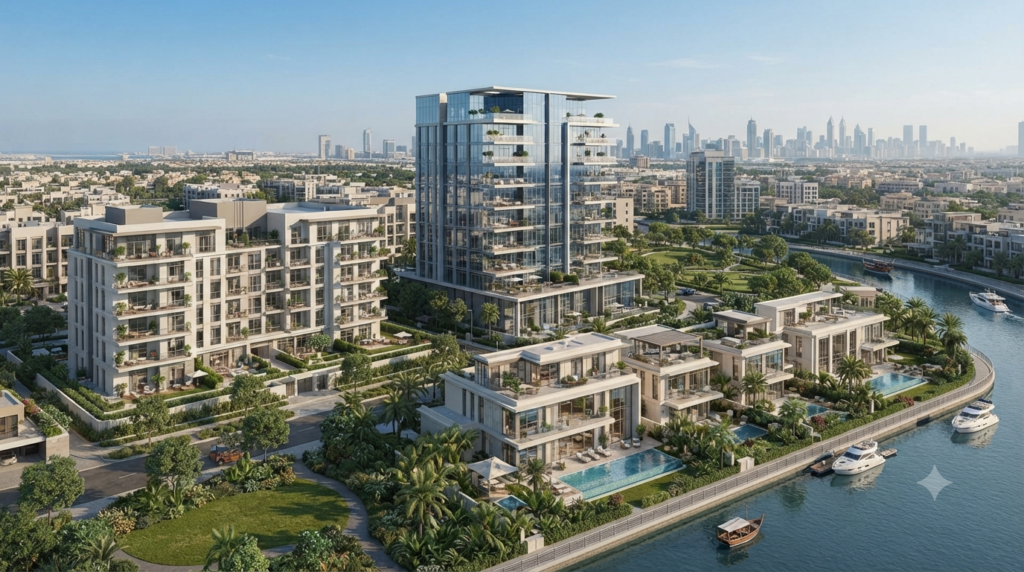
One of the most common assumptions among Delhi investors is that Dubai property is expensive and out of reach for most budgets. This is incorrect.
Dubai’s freehold market covers a wide price range. Entry points start from approximately INR 1.38 Crores for studio apartments in established communities. This sits comfortably within the annual LRS limit for a single resident Indian investor.
Understanding the price landscape across property types and communities removes the biggest barrier most Delhi investors have to answering the question can we buy property in Dubai for ourselves.
Entry-Level Investment: INR 1.38 to 2.5 Crores
At the entry level, Delhi investors can purchase studio and compact one-bedroom apartments in communities like Jumeirah Village Circle, Arjan, Dubai Silicon Oasis, and Jumeirah Lake Towers.
These properties regularly deliver rental yields of 9 to 11% annually. At INR 1.38 Crores earning 9%, the annual rental income runs approximately INR 12.4 Lakhs, with zero UAE tax applied.
Developers active in this price range include Danube, Imtiaz, and Binghatti, all of whom offer off-plan payment plans requiring only 10% upfront. For a full price breakdown by community and property type, read our article on Dubai property prices in Indian rupees.
Mid-Range Investment: INR 2.5 to 6 Crores
The mid-range segment opens up larger one-bedrooms and two-bedroom apartments in Business Bay, Dubai Marina, and Downtown Dubai. These communities offer a different profile: slightly lower gross yields at 6 to 9% but stronger historical capital appreciation and a higher-income tenant base.
Within the two people combining LRS limits, this entire segment is accessible to Delhi households. Many couples from Gurgaon and South Delhi have entered this bracket specifically to target the premium tenant market in Business Bay.
Premium Investment: INR 6 Crores and Above
The premium segment covers Dubai Marina penthouses, Palm Jumeirah apartments, and villa communities like Arabian Ranches and DAMAC Hills. These assets attract high-net-worth international tenants, long-term corporate leases, and some of the strongest capital growth histories in Dubai.
Premium assets also offer a specific financial benefit for Delhi investors. Properties above AED 2 million, approximately INR 4.65 Crores, qualify for the UAE Golden Visa, granting 10-year renewable UAE residency to the investor and their immediate family.
Can We Buy Property in Dubai Off-Plan?

Off-plan is the most popular purchase format among Indian buyers in Dubai. It means buying a property before or during its construction phase, at a launch price lower than the expected ready-unit value.
When Delhi investors ask whether we can buy property in Dubai without a full upfront payment, off-plan is the answer. The installment structure of off-plan projects is specifically designed to make Dubai accessible to investors who need to manage cash flow carefully.
How Off-Plan Payments Work for Indian Buyers
Off-plan developers in Dubai offer structured payment plans that spread the purchase cost over 3 to 7 years. A standard plan requires 10% at booking, 30% during construction linked to milestones, and 60% either at handover or in post-handover installments.
Critically, zero interest applies to these deferred payments. The developer absorbs the time value of money into the project economics. This is fundamentally different from an Indian home loan, which carries significant interest costs over the loan term.
For Delhi investors managing LRS limits, off-plan installments can be spread across multiple financial years, keeping each annual remittance within the USD 250,000 cap.
Capital Appreciation Between Launch & Handover
Off-plan properties are priced at a discount to their expected ready-market value at handover. Investors who buy at launch and sell at or after completion capture the appreciation between those two price points.
According to data from the Dubai Land Department, off-plan properties in high-demand communities have historically appreciated 20 to 40% between launch and handover in recent project cycles. Zero capital gains tax in the UAE means this entire gain belongs to the investor.
Risks of Off-Plan Buying and How to Manage Them
Can we buy property in Dubai off-plan without risk? No investment is risk-free. Off-plan carries construction delay risk and developer performance risk.
However, RERA requires all off-plan developers to hold buyer payments in escrow accounts during construction. Funds are released only when verified construction milestones are reached. This protects your investment if a project runs late.
Choosing developers with a strong delivery track record eliminates most practical off-plan risk. Emaar, Sobha, Binghatti, and DAMAC all have long histories of delivering completed projects on schedule. For a full risk assessment, read our complete guide on risks of buying property in Dubai and how to avoid them.
Frequently Asked Questions
Can we buy property in Dubai without visiting the UAE?
Yes. Many Indian investors complete the entire transaction remotely from Delhi. The SPA can be signed digitally or through a Power of Attorney. Funds are transferred via LRS through your Indian bank. The Title Deed is issued digitally through the DLD portal. No UAE visit is required.
Can we buy property in Dubai as a salaried professional, not just a business owner?
Absolutely. There is no employment type restriction on buying Dubai property from India. Any resident Indian with a valid PAN card, bank account, and savings within LRS limits can purchase legally, whether salaried, self-employed, or a business owner.
Can we buy property in Dubai jointly with a family member who is an NRI?
Yes. A resident Indian and an NRI can jointly purchase a Dubai property. Each uses their respective remittance framework, LRS for the resident and NRE or NRO account remittance for the NRI. Both names appear on the Title Deed, and both hold legal ownership rights.
Can we buy property in Dubai and rent it out immediately?
Ready properties can be rented from the day of purchase. Off-plan properties cannot be rented until handover. For immediate rental income, focus on ready units in high-occupancy communities like JVC, JLT, or Business Bay.
Can we buy property in Dubai and get UAE residency?
Properties above AED 2 million qualify the buyer for the UAE Golden Visa, a 10-year renewable residency for the investor and their immediate family. Properties below this threshold do not automatically qualify for residency but do entitle the owner to apply for a renewable property owner visa in some categories.