Quick Answer:
-
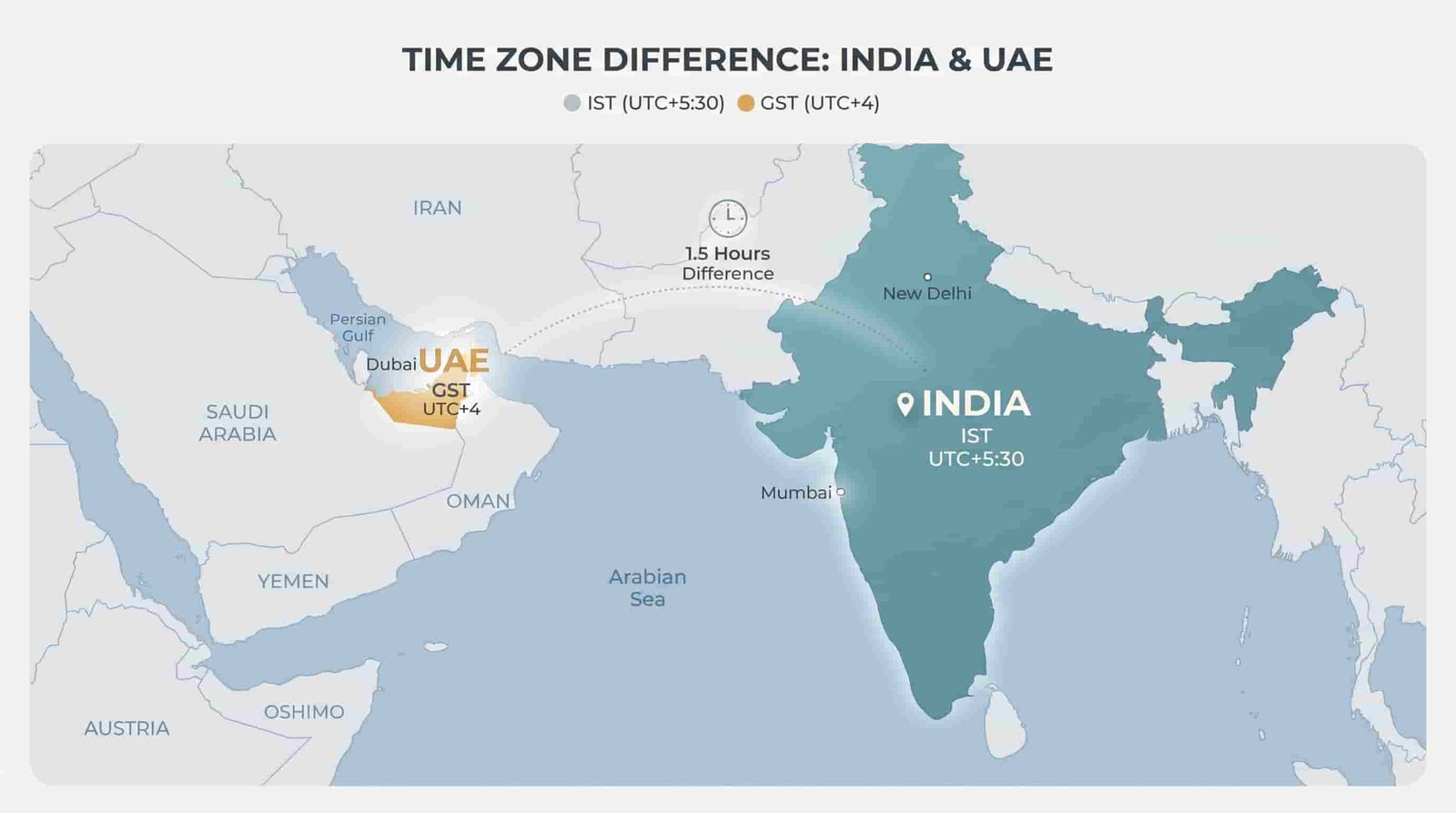
The gap: India runs 1 hour 30 minutes ahead of Dubai.
-
The zones: India keeps IST (UTC+5:30), Dubai keeps GST (UTC+4).
-
All year: neither side uses daylight saving, so the gap never moves.
-
Every city: India keeps one time zone, so Dubai trails all of it by 1.5 hours.
-
For buyers: that small gap makes Dubai easy to deal with.
India is 1 hour 30 minutes ahead of Dubai. When your clock in Mumbai or Delhi shows 12:00 noon, a clock in Dubai shows 10:30 in the morning. That is the whole answer, and it holds every day of the year.
India runs on India Standard Time, or IST, which sits at UTC+5:30. Dubai runs on Gulf Standard Time, or GST, at UTC+4. Subtract one from the other and you land on the 90-minute gap. When people ask about dubai time vs india time, this fixed number is what they are really after.
This guide covers the exact gap, a clock-by-clock table, the reason behind the odd half hour, and what it all means for a buyer. The time difference between India and Dubai is only half the picture, though. For how far apart the two places actually sit, see our guide to the Dubai Delhi distance.
We confirmed every time here against the official Worldometer time page for Dubai on 20 October 2026.
The Exact Time Gap
The time difference between India and Dubai is a flat 1 hour 30 minutes, with India in front. Nothing rounds it off and nothing shifts it with the seasons. Read the clock in India, take off ninety minutes, and you have the time in Dubai.
Hours Apart
India leads Dubai by 1 hour 30 minutes. Flip it around and Dubai trails India by the same 1.5 hours. So is Dubai behind India? Yes, by an hour and a half, every single day. When your phone shows 8:00 in the evening at home, a friend in Dubai is just sitting down to dinner at 6:30.
Both Zones
That gap comes straight from the clock each country keeps. India uses India Standard Time at UTC+5:30, and Dubai uses Gulf Standard Time at UTC+4. To turn IST to GST, you simply drop that hour and a half. The reference above shows Dubai holding "no changes, UTC +4 hours" right across 2020 to 2029, so the Dubai side never budges.
The table below turns the rule into real clock times, reading from an Indian clock across to a Dubai one.
|
India (IST) |
Dubai (GST) |
|---|---|
|
6:00 am |
4:30 am |
|
9:00 am |
7:30 am |
|
12:00 noon |
10:30 am |
|
3:00 pm |
1:30 pm |
|
6:00 pm |
4:30 pm |
|
9:00 pm |
7:30 pm |
So every Indian time lands ninety minutes earlier on a Dubai clock. Learn that one move and you can throw the converter away. The time difference between India and Dubai really is that easy to use.
Here is how it plays out in real life. Say you want to catch a Dubai developer early in their afternoon, around 2:00 pm their time. Add the ninety minutes and you make the call at 3:30 pm from India, still comfortably inside your own working day. No late nights, no dawn alarms.
Now for the bit that trips most people up: why the gap is not a neat whole hour.
Why The Odd Half Hour
Most country-to-country gaps come out as a round number of hours. India to Dubai does not, and India's own clock is the reason. That extra half hour sits entirely on the Indian side. Dubai does nothing unusual.
Fixed Year-Round
Neither India nor the UAE touches its clocks for daylight saving. A standard reference shows India keeps a single time zone with no daylight saving changes, and Dubai holds UTC+4 right through the year. That makes the time difference between India and Dubai far easier to live with than most.
Call London or New York from India and the gap slides by an hour twice a year, as those cities spring forward and fall back under US daylight saving rules. India to Dubai never does that. The 1.5-hour gap you learn today is the same gap in June, in December, and every month in between.
One Indian Zone
India runs on one clock from Kochi in the south to Delhi in the north. No second zone, no regional change. So Dubai sits 1.5 hours behind every Indian city by the exact same amount. Whether your family is in Chennai, Bengaluru, Ahmedabad, or Kolkata, the Dubai time zone lands the same ninety minutes behind each of them.
That one-clock rule keeps things simple wherever you are. A few quick moves cover almost every case:
-
India to Dubai: subtract 1 hour 30 minutes from the Indian time.
-
Dubai to India: add 1 hour 30 minutes to the Dubai time.
-
Same date, almost always: the gap is small, so the day rarely changes when you convert.
-
No seasonal maths: the rule holds every month, because no clocks move.
Calling And Meeting Times
A ninety-minute gap is about as easy as a time difference gets. Indian and Dubai office hours sit almost on top of each other. So your call, video meeting or quick message reaches the other person right in the middle of their working day. This is where the small gap stops being trivia and starts earning its keep.
Working Hours Overlap
A normal Indian office day of 10:00 to 6:00 lines up neatly with a Dubai day of 8:30 to 4:30. The UAE runs a Monday to Friday week too, which the UAE government confirms, so your working weeks match as well. The overlap is nearly total. You rarely have to puzzle over the best time to call dubai from india, because almost any hour in your own office day reaches a Dubai office that is open. Your late morning is the safest bet, since it is still mid-morning over there.
Expo And Handover
The same ease carries straight over to property. You can take a handover video call, fire a quick question to a Dubai agent, or walk through a unit live, all inside one shared working day. If you would rather come in person, our Dubai property expo Delhi guide tells you what to expect on the day.
A few simple habits keep the small gap working in your favour:
-
Call in your late morning: it is still mid-morning in Dubai, so offices are fresh and open.
-
Send documents by your afternoon: they reach Dubai with hours of the working day left.
-
Book calls on weekdays: both India and the UAE run a Monday to Friday week.
-
Skip the converter: just subtract ninety minutes, and you have the Dubai time.
The table below gives safe windows for common reasons an Indian buyer contacts Dubai.
|
Purpose |
India time |
Dubai time |
Note |
|---|---|---|---|
|
Morning agent call |
11:00 am |
9:30 am |
Both offices open |
|
Lunch-hour message |
1:30 pm |
12:00 noon |
Reaches midday in Dubai |
|
Afternoon handover call |
4:00 pm |
2:30 pm |
Full working overlap |
|
Evening catch-up |
7:00 pm |
5:30 pm |
End of the Dubai day |
|
Thinking about buying in Dubai from India? The small time gap is one less thing to worry about. My team works across both clocks every day. We line up your calls, walkthroughs and paperwork at hours that suit you, and we make sure nothing sits waiting overnight. We handle the Dubai side, so dealing with it feels no harder than a call across your own city. |
With the clock sorted, the real question for a buyer is what this closeness means when you own a property far from home.
Why It Matters For Buyers
For an Indian buyer, a time zone is not a small detail. It decides how hard it is to run a home you own in another country. A wide gap breeds missed calls and overnight waits. The time difference between India and Dubai, at a mere ninety minutes, spares you almost all of that.
Easy To Manage
Line Dubai up against the usual overseas choices for an Indian investor. A home in the United States can trail you by nine to twelve hours, so one simple question waits a whole day for its answer. Australia runs hours ahead. Dubai sits a gentle 1.5 hours behind, still inside your own day. That is a plain, practical reason the Gulf suits Indian buyers who like to stay hands-on.
The table below puts the main overseas markets side by side on the one thing that decides how easily you can run a home from India: the clock gap.
|
Market |
Gap from India |
Daylight saving |
Same-day dealing |
|---|---|---|---|
|
Dubai (UAE) |
1.5 hours behind |
none |
yes |
|
United Kingdom |
4.5 to 5.5 hours behind |
yes, shifts twice a year |
partly |
|
United States (East) |
9.5 to 10.5 hours behind |
yes, shifts twice a year |
no |
|
Australia (Sydney) |
4.5 to 5.5 hours ahead |
yes, shifts twice a year |
partly |
Same Business Day
Because the working days overlap, the whole chain of a deal moves inside one day. You send a document request, a bank transfer query or a question to the developer, and the reply comes back while both sides are still awake. Glance at the Dubai time now in India, and you will nearly always find it is still the same working day over there. When you need to move the money across, our guide to transfer money from India to Dubai walks you through the steps.
That same-day rhythm really helps when a decision cannot wait. If a developer asks you for a document or a sign-off, you answer and move on before the day ends, instead of losing a night to a far-off office. Before you commit to anything, though, know the pitfalls as well. Our guide to the risks of buying property in Dubai lays them out in plain terms.
The small gap turns into a list of everyday wins:
-
Same-day replies: questions get answered before you sleep, not after.
-
Live handover calls: watch your unit handed over in real time.
-
No overnight lag: paperwork does not stall waiting for a far-off office to wake.
-
Easy follow-ups: a second call the same afternoon is simple to arrange.
Put it together and the picture is clear. India keeps IST at UTC+5:30, Dubai keeps GST at UTC+4, neither moves for daylight saving, and the working days overlap. Every one of those points pulls the same way: Dubai is easy to deal with, not just close on a map.
For a fuller picture of what daily life costs on the ground, read our cost of living in Dubai vs India comparison.
Buyers in every Indian city see the same thing, which is why people right across the country find Dubai simple to work with. The time difference between India and Dubai works the same for all of them. Our Mumbai property expo network guide shows how buyers in another big metro handle the very same gap.
See Dubai For Yourself
The time difference between India and Dubai comes down to one easy fact. India stays ninety minutes ahead; it never changes, and the gap reads the same from every Indian city. For a buyer, that closeness is a quiet advantage. You call, meet and settle paperwork with Dubai inside your own working day, with no overnight waits and no seasonal clock maths to track.
Want to see the real market and put your own questions to someone face to face? Register for the Expo and meet our team in your city.
Frequently Asked Questions
What is the time difference between India and Dubai?
India runs 1 hour 30 minutes ahead of Dubai. India keeps IST (UTC+5:30) and Dubai keeps GST (UTC+4). Neither side uses daylight saving, so that gap holds steady all year.
Does Dubai run ahead or behind the Indian clock?
Dubai sits 1 hour 30 minutes behind India. When your clock at home reads 9:00 in the evening, Dubai reads 7:30. It never flips, because both countries keep a fixed clock.
Does the gap change in summer or winter?
No. India and the UAE both skip daylight saving, so the 1.5-hour gap stays identical every month. Compare that with the US, the UK or Europe, where the difference shifts twice a year.
Why is there an extra half hour?
That half hour comes from India, not Dubai. India Standard Time runs at UTC+5:30, one of the world's rare half-hour offsets. Dubai sits on a clean whole hour at UTC+4, so the 30 minutes is entirely India's doing.
What time is it in Dubai at noon in India?
Noon in India is 10:30 in the morning in Dubai. For any Indian time, take off 1 hour 30 minutes to get Dubai. Going the other way, add the same.
Is the gap the same from Mumbai and Bengaluru?
Yes. India keeps one time zone across the whole country, so Dubai trails Mumbai, Bengaluru, Delhi, Chennai and every other Indian city by the identical 1.5 hours.
When should an Indian buyer call a Dubai office?
Aim for your late morning. An 11:00 am call from India reaches a Dubai office at 9:30 am, when both sides are open. Honestly, almost any hour in your own office day works, because the two days overlap so well.